

Remains of the day —
Dark Energy Camera captures rare view of RCW 86, remnant of supernova recorded in 185 CE.
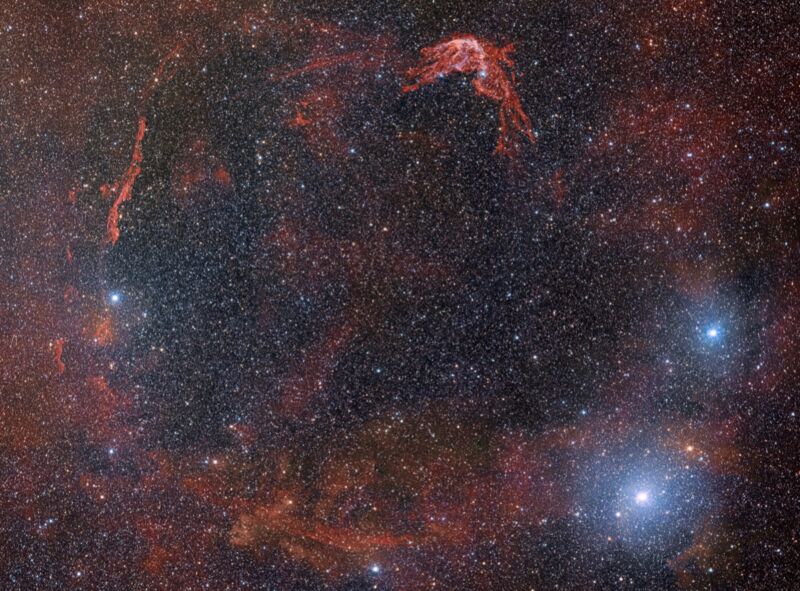
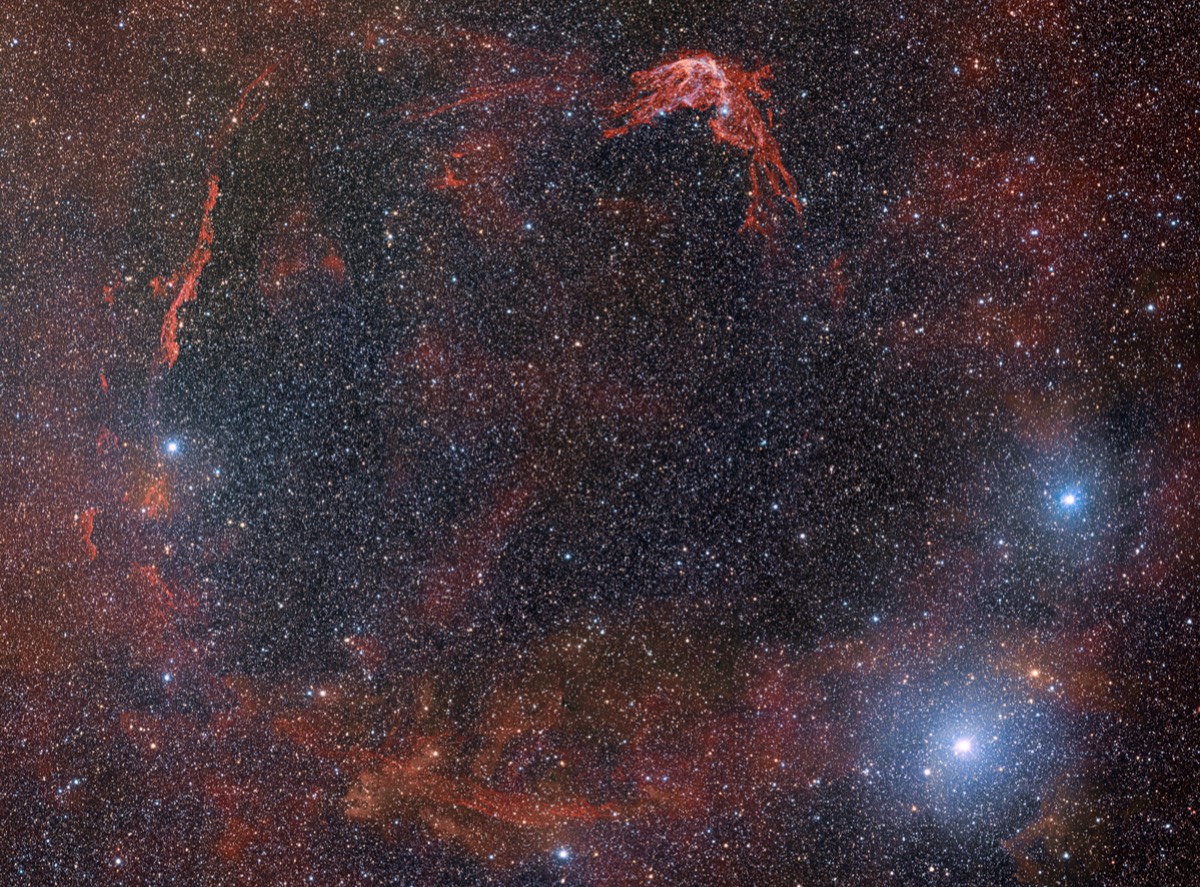
Enlarge / The tattered shell of the first recorded supernova (Sn185) was captured by the Dark Energy Camera. This image covers an impressive 45 arcminutes in the sky—a rare view of the entirety of this supernova remnant.
CTIO/NOIRLab/DOE/NSF
In early December 185 CE, Chinese astronomers recorded a bright “guest star” in the night sky that shone for eight months in the direction of Alpha Centauri before fading away—most likely the earliest recorded supernova in the historical record. The image above gives us a rare glimpse of the entire tattered remnant of that long-ago explosion, as captured by the Dark Energy Camera (DECam), mounted on the four-meter telescope at the Cerro Tololo Inter-American Observatory in the Andes in Chile. DECam has been operating since 2012, and while it was originally designed to be part of the ongoing Dark Energy Survey, it’s also available for other astronomers to use in their research. This new wide-view perspective of the remains of SN 185 should help astronomers learn even more about stellar evolution.
As we’ve written previously, there are two types of known supernovas, depending on the mass of the original star. An iron-core collapse supernova occurs with massive stars (greater than 10 solar masses), which collapse so violently that it causes a huge, catastrophic explosion. The temperatures and pressures become so high that the carbon in the star’s core fuses. This halts the core’s collapse, at least temporarily, and this process continues, over and over, with progressively heavier atomic nuclei. When the fuel finally runs out entirely, the (by then) iron core collapses into a black hole or a neutron star.
Then there is a Type Ia supernova. Smaller stars (up to about eight solar masses) gradually cool to become dense cores of ash known as white dwarfs. If a white dwarf that has run out of nuclear fuel is part of a binary system, it can siphon off matter from its partner, adding to its mass until its core reaches high enough temperatures for carbon fusion to occur. These are the brightest supernovae, and they also shine with a remarkably consistent peak luminosity, making them invaluable “standard candles” for astronomers to determine cosmic distances.
There are precious few details about SN185 provided in the Book of Later Han, other than it was the “size of a bamboo mat,” and “displayed various colors, both pleasing and otherwise.” Astronomers suspected there might be a link between SN 185 and the remnant structure dubbed RCW 86, but for a long time, they assumed the event that formed RCW 86 had been a core-collapse supernova, which would require some 10,000 years for the remnant structure to achieve its present form.
In 2006, new X-ray data gathered by the European Space Agency’s XMM-Newton Observatory and NASA’s Chandra X-Ray Observatory demonstrated that RCW 86 is much younger than previously thought: about 2,000 years old. The authors were able to calculate how quickly the shockwave within RCW 86 was expanding. They found that there are denser spots where the shockwave is expanding more slowly, misleading astronomers into thinking the remnant was older than it is. But there are other regions where the shockwave is still inside the bubble—and still expanding rapidly—that provide a more accurate estimate of RCW 86’s age.
The new age estimate significantly strengthened the case that RCW 86 is the remnant of SN 185. In that case, SN 185 was probably a Type Ia supernova, a conclusion based in part on the discovery that there is a large amount of iron present in the remnant. A white dwarf star devouring its partner in a binary system produced high-velocity winds, pushing gas and dust outward and creating a cavity before the white dwarf exploded. That enabled all that debris to expand outward very rapidly to create the impressive tattered structure that exists today.
Jennifer Ouellette is a senior writer at Ars Technica with a particular focus on where science meets culture, covering everything from physics and related interdisciplinary topics to her favorite films and TV series. Jennifer lives in Los Angeles.
Read More
Jennifer Ouellette