

As was foretold, T-Mobile customers can now grab their free subscription to MLS Season Pass on Apple TV. It’s part of the “T-Mobile Tuesdays” incentive that gives subscribers free stuff throughout the year, and the latest in a string of streaming-related freebies made available by the wireless provider.
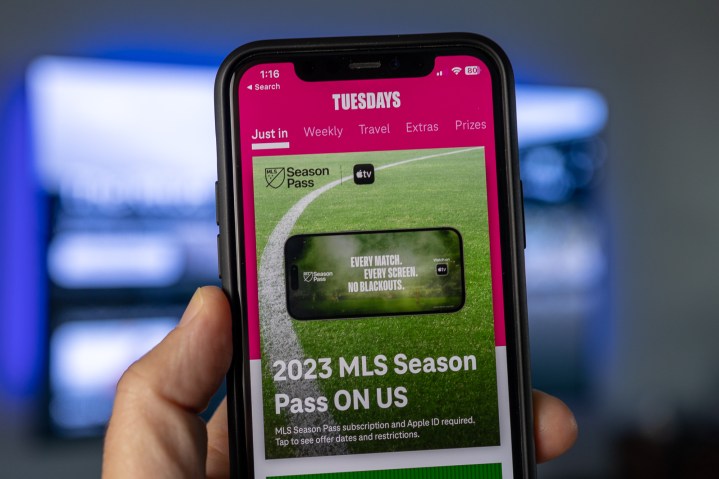
All you’ll need to make good on the promotion is a T-Mobile account and the T-Mobile Tuesday app. From there, you’ll be prompted to redeem a unique code. Log in to your Apple account, use that unique code, and you’re good t ogo.
Once that’s taken care of, you’ll also need the Apple TV app, which is easy enough since it’s available on pretty much any modern streaming platform, from Roku to Amazon Fire TV, Google TV and Android TV — and of course on the Apple TV hardware. It’s also available on various smart TVs. And if none of that applies to you, Apple TV also is available in a web browser.
Simple enough. And after that, you’ll be able to watch every single MLS game this season, including the playoffs later this year — and all without blackout restrictions. You’ll also be able to watch MLS Next and MLS Next Pro developmental games, watch features on your favorite players and teams, and catch pregame and post-game analysis.
For those who don’t have T-Mobile, MLS Season Pass is now available for $15 a month ($100 for the season) if you don’t also subscribe to Apple TV+, or $13 a month (or $80 a season) if you do.
There is a tiny bit of fine print here, too. The freebie is only good for the 2023 season, and you’ll have to redeem your code by 4:59 a.m. ET on March 14.
Other than that, enjoy the freebie, and enjoy the games.

Today’s tech news, curated and condensed for your inbox
Check your inbox!
Please provide a valid email address to continue.
This email address is currently on file. If you are not receiving newsletters, please check your spam folder.
Sorry, an error occurred during subscription. Please try again later.
Editors’ Recommendations
-
MLS Season Pass: price, how to watch, and more -
MLS Season Pass will be available to sports bars and the like -
MLS Season Pass tops out at 1080p — here’s why that’s probably OK -
YouTube TV: plans, pricing, channels, how to cancel, and more -
Apple AirPlay 2 supports 24-bit lossless audio, but you can’t use it
LG brings Apple TV, Apple Music, and AirPlay to webOS Hub-based TVs
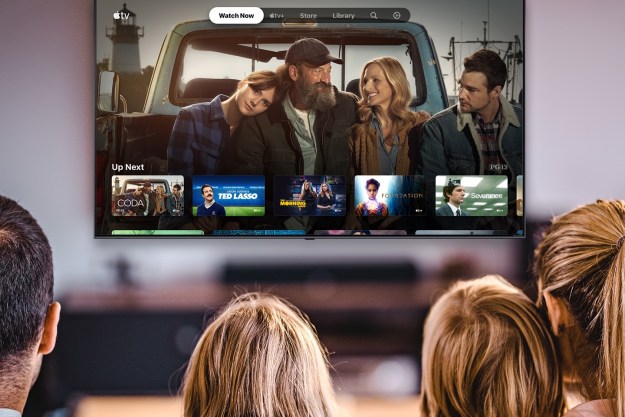
In October 2022, LG debuted webOS Hub, an enhanced version of the smart TV software it uses for its own TVs that can be licensed by other manufacturers. At the time, webOS Hub was not a full replica of the webOS that runs on LG TVs, given that it was missing some features like Apple’s AirPlay and HomeKit support.
Today, LG says that webOS Hub is now compatible with all of those missing Apple ingredients. Apple TV app, Apple Music, AirPlay, and HomeKit are available to compatible webOS Hub TVs in more than 100 countries and regions.
McIntosh’s new $8,000 AVR: gigantic power, with a Dolby Atmos catch

New York-based prestige audio brand McIntosh this week launched the MHT300, an $8,000, 7.2-channel home theater receiver that boasts a monstrous 120 watts to 150 watts per channel of power. That’s right: up to 1,050 total watts. But what’s impressive about this is that all that legendary McIntosh power is distributed to all seven channels, making for some serious movie-watching sound from all directions. Well, kinda.
The McIntosh MHT300 Home Theater Receiver will let you hear “every explosion, car chase, and high-speed fighter jet flyby,” according to a press release, at 120 watts per channel into 8-Ohm speakers or 150 watts per channel with 4-Ohm speakers, with all seven channels driven.
Netflix expands its spatial audio, number of devices that can download content

Netflix Premium subscribers are getting an enhancement to their service starting today. The streaming company has increased the number of devices that can download content for offline viewing from four to six. It’s also expanding the spatial audio feature it launched in 2022, making spatial audio available on its top 700 titles. The new features are included in the current price of a Premium plan.
Spatial audio on Netflix is similar to Dolby Atmos — it creates a much more immersive, 3D-like audio experience where sounds feel like they’re moving independently of the rest of the soundtrack. However, unlike Dolby Atmos, Netflix’s spatial audio can be experienced on any device that has stereo speakers whether they are Dolby Atmos-capable or not.
Read More
Phil Nickinson