

Science & Nature
The rapid retreat of Thwaites Glacier in West Antarctica appears to be driven by processes under its floating ice shelf that are different than researchers realized.
Two papers published in the journal Nature provide a clearer picture of the changes taking place under the glacier, which is the size of Florida and is one of the fastest-changing ice-ocean systems in Antarctica.
The results show that, although melting has increased beneath the floating ice shelf, the present rate of melting is slower than many computer models currently estimate.
New observations determining where the ice enters the ocean show that, while melting beneath much of the ice shelf is weaker than expected, melting in cracks and crevasses is happening much faster. The findings are an important step in understanding the glacier’s contribution to future sea-level rise, scientists say.
A layer of fresher water between the bottom of the ice shelf and the underlying ocean slows the rate of melting along flat parts of the ice shelf. However, scientists were surprised to see that the melting had formed a staircase-like topography across the bottom of the ice shelf. In these areas, as well as in cracks in the ice, rapid melting is occurring.
Thwaites Glacier’s grounding zone — the point where it meets the seafloor — has retreated 14 kilometers, or 8.7 miles, since the late 1990s. Much of the ice sheet is below sea level and susceptible to rapid, irreversible ice loss that could raise global sea level by more than half a meter (1.64 feet) in centuries.
The new data were collected as part of the MELT project, an effort in the U.S.-U.K. International Thwaites Glacier Collaboration, among the largest international field campaigns ever undertaken in Antarctica. The MELT team took observations of the grounding line beneath the Thwaites Eastern Ice Shelf to understand how the ice and ocean interacts in this region.
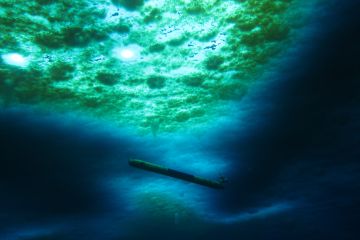
U.S. National Science Foundation-supported scientist Britney Schmidt of Cornell University and a team of scientists and engineers deployed a robot called Icefin through a 600-meter-deep (1,969-feet-deep) borehole.
The vehicle is designed to access such grounding zones, which were previously almost impossible to survey. The observations Icefin made of the seafloor and ice around the grounding zone provide more detail on how melting varies beneath the ice shelf.
The researchers found that the staircases, called terraces, as well as the crevasses in the ice base, are melting rapidly. Melting is especially important in crevasses. As water funnels through them, heat and salt can be transferred into the ice, further widening the crevasses and rifts.
“These important observations demonstrate the value of hard-won, on-the-ground observations from these remote locations,” said Paul Cutler, a program director in NSF’s Office of Polar Programs.

Read More
NSF