

This piece was previously titled “The High Cost of Expensive Housing (and How Auckland Fixed it)”. I’ve changed it
One of the most important questions in the developed world today is: Why is the cost of housing so high? In many countries the price of housing has gone to levels that threaten financial stability for renters, and buying a house has become unaffordable for many. As The Housing Theory of Everything notes:
Average New York City metropolitan area house prices are up 706% since 1980 (or 376% more than US consumer prices, and 326% more than US wages). For San Francisco the rise is 932%. London house prices are up over 2,100% in that period (or around 1,500% more than wages). Prices in Sydney, Australia, have risen by 1,450% (compared to hourly wage increases of 480%).
Why is this? One possible reason is that the supply of housing has reduced, which leads to higher prices. Along with that, demand has gone up for buying new houses due to lower interest rates, which also increases housing prices. Both of these things have happened simultaneously. There has been a generational decline in interest rates across the developed world (although it has reversed in the last 2 years), but the affordability crisis is concentrated in large cities.
There is a large body of evidence showing that the issue mainly, is supply. Interest rates have gone down across countries, and in any country the interest rate across it is the same. But the price of housing is unaffordable mainly in some large cities, and not all over the country. One good paper on this is Glaeser et. al (2002) titled “Why is Manhattan So Expensive: Regulation and the Rise In House Prices”. The authors ask the obvious question: if homebuilding is a competitive industry, then why don’t prices fall to the cost of building a home? After all this happens for all other industries like pens, pencils, computers etc. What makes housing so special?
They conclude that the main reason is that land use regulations in New York make this impossible. One of the key assumptions of the model above is that there are no barriers to entry, and anyone who spots high house prices can build new houses and enjoy the profits of it. But the issue is that land use regulations (also called zoning laws) restrict the supply of housing. They impose minimum size requirements, they require permission of local authorities, they require parking lot requirements etc. While some of these might be justified for safety reasons, it is unlikely that all of them can be justified, and the cumulative effect of all of them is to massively restrict housing supply.
This in turn increases the price of housing, which makes it unaffordable for people to buy and rent houses. A literature review by Gyourko and Molloy (2015) confirms this, as do other papers for Australia, New Zealand, and the United Kingdom.
Now, if you are a renter or a prospective homebuyer, you probably sympathize with the problems here. Finding a house is pretty hard these days! It causes anxiety and uncertainty for renters and buyers. You have to pay high prices, and deal with unreasonable landlords. And in the end, all of it just to get a roof above your head.
But the costs of housing regulations are not just on homebuyers: they have a cost on the overall economy. One way is that people take on more debt, which leads to financial instability for them, and the financial system as a whole. But another more important way is that it leads to poor spatial allocation.
(The word spatial allocation is just academic speak for “where are people located”)
One of the most important facts about cities is that they make people intensely more productive. If you’re living in the middle of nowhere, you don’t have people to talk to, you don’t have companies to work at, coworkers to gossip with, employees to hire, many restaurants to eat at etc. The value of density for the individual person is extremely high!
When people live and work close to each other, the increased density leads to them being more productive. Because they are closer to each other, they can produce more output than they could if they were far apart. This is what makes cities such great places
But as you have noticed, cities have extremely restrictive zoning laws which lead to high housing prices. This means that people can’t afford to live in cities. They’re priced out by the high housing costs! For each person it means that they can’t get the benefits of living in the city. But the economy as a whole produces less output because people aren’t in those cities.
If two highly talented tech workers can’t live in San Francisco because of the high housing prices, it is not only a loss to them that they lose income, but it is a loss to everyone else that they will not be able to do something amazing there (like start a company, or work for the next multibillion dollar one). As cities have become more dependent on intangible capital, the value of ideas is very high. And one of the best ways to create new ideas and to spread them is to be part of a high density environment where other people are also talking about those ideas.
So, when people are priced out of large cities and aren’t able to produce more, it is a cost for everyone in the world who would have benefitted from their production otherwise. High housing in big cities means lesser tech companies from San Francisco, lesser biotech startups from Oxbridge, lesser finance companies in New York and you get the idea.
This intuition is demonstrated in Hsieh and Moretti’s 2019 paper:
We quantify the amount of spatial misallocation of labor across US cities and its aggregate costs. Misallocation arises because high productivity cities like New York and the San Francisco Bay Area have adopted stringent restrictions to new housing supply, effectively limiting the number of workers who have access to such high productivity. Using a spatial equilibrium model and data from 220 metropolitan areas we find that these constraints lowered aggregate US growth by 36 percent from 1964 to 2009
And that cost is a meaningful number! The average American would have had $3,600 more in annual income just by this change in those two cities.
A cynic might reply that these models are interesting, but unrepresentative of reality. After all, they’re just models on paper. Who knows what happens in real life? Fortunately for newsletter writers such as myself, the government of New Zealand provided a policy experiment so we could find out.

Jacinda Ardern, NZ’s Prime Minister (via Vogue)
Auckland fits our model in many ways. It is a city with immense importance to New Zealand, accounting for 37% of GDP, had immense problems of housing affordability that were caused because of regulations that restricted supply. In theory, this is the perfect place to test the research in the above pages.
And so in 2016, Auckland liberalized house building rules by allowing more dense housing, allowing more housing overall and removing parking restrictions among other changes. If the theory is correct, two things should happen:
There should be a boom in construction in Auckland because builders can get permits easily
There should be a reduction, or at least a lesser rate of growth in Auckland Housing prices
Both of these happened to a large extent.
Here is a graph from an article about New Zealand’s housing reforms showing the increase in housing construction
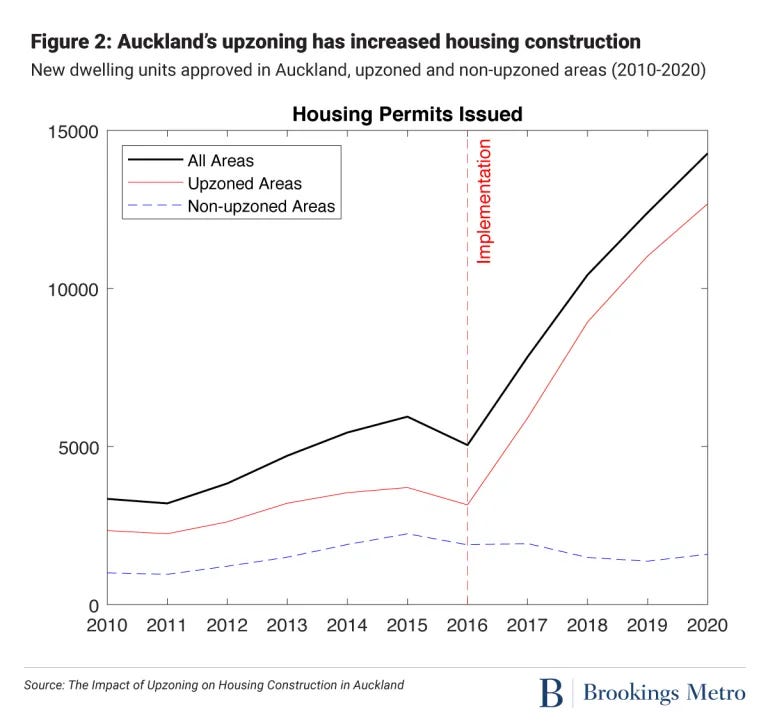
This graph provides unmistakable evidence that zoning rules were holding back Auckland’s housing construction. Housing construction overall increased, and construction in upzoned areas increased much more than those that were not. This is as close to the best evidence one can get for the value of removing zoning restrictions.
The second piece of evidence is that rental prices are growing slower in Auckland than they are in other cities in New Zealand. And as one would expect, housing prices fell in upzoned areas. As one paper concluded:
intensively developed properties decrease in value relative to similar dwellings that were not upzoned, showing that the large-scale upzoning had an immediate depreciative effect on preexisting intensive housing.
Tons of research has determined that restrictive land use regulations are a key determinant of housing prices. It’s not just economics papers that say it, it’s also real world evidence from cities like Auckland that housing is just like any other good: if you build more of it, it will be less expensive.
The trillion dollar question is: if it’s so obvious, why aren’t we already doing it?
The answer to this jumps from the realm of economics to that of politics. Local interest groups, informally known as NIMBYs (Not In My Backyard) oppose it for reasons including noise, the fact that it might reduce their house prices, they don’t want to bear the sound and noise of construction etc.
Placating such groups (one good example is this) is one of the most important political problems of our time if we want to reduce housing costs. I’ll leave that to the relevant experts.
Read More
Sharie Drews