

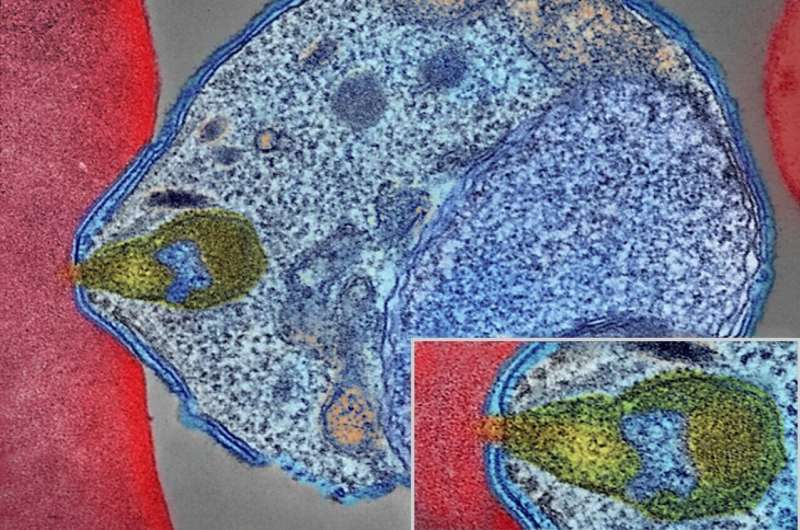
A monoclonal antibody treatment was found to be safe, well tolerated, and effective in protecting against malaria in a small group of healthy volunteers who were exposed to malaria in a challenge study, according to new research published in The Lancet Infectious Diseases by researchers at the University of Maryland School of Medicine (UMSOM).
“The study demonstrates the feasibility of using monoclonal antibody therapies to help prevent malarial infection and holds promise for deployment to places where the disease is endemic,” said Kirsten Lyke, MD, Professor of Medicine and Director of the Malaria Vaccine and Challenge Unit in the Center for Vaccine Development and Global Health (CVD) at UMSOM. “This may allow us to revisit malaria eradication efforts.”
There were 241 million malaria cases and 627,000 deaths reported worldwide in 2020 alone, which is a 12 percent increase from 2019. Public health experts contend new strategies are urgently needed to achieve the United Nation’s sustainable development goal of 90 percent reduction in malaria incidence and mortality by 2030. Scientists have tried for decades to develop a highly effective malaria vaccine without much success.
Monoclonal antibodies represent a promising approach to reduce malaria morbidity and mortality, and they offer a new tool for use in in preventing infection. Highly effective malaria vaccines have so far been elusive since they have not been shown to provide much protection in those who have already been infected with malaria earlier in life, but numerous trials conducted by CVD investigators show promise in this arena as well.
CVD was the first center in the world to develop controlled human malaria infection studies, providing proof of principle that live attenuated malaria vaccines protect against infection. CVD researchers conducted genome-wide studies of antimalarial drug resistance and have tested monoclonal antibodies for treating malaria. This is the first time they have tested an experimental monoclonal antibody in a challenge study in a CVD lab in Baltimore.
The new research describes the final dose selection section of a three-part clinical trial. The monoclonal antibody CIS43LS provided high levels of protection in the first two parts of the trial, in which researchers administered 20 or 40 milligrams per kilogram (mg/kg) of the monoclonal antibody via IV infusions. In the current study, 29 healthy study participants, ages 18 to 50 years—who had no prior malaria infections or vaccinations—received a single dose of CIS43LS in doses of 1, 5, or 10 mg/kg via IV infusions, or by subcutaneous injection (injected just under the skin).
Study participants were bitten by five mosquitoes infected with a Plasmodium falciparum strain of malaria about eight weeks after they were given the monoclonal antibody. A single dose of CIS43LS at 5-10 mg/kg administered subcutaneously or intravenously provided high level protection against a controlled human malaria infection with partial protection achieved at 1 mg/kg administered intravenously. Eight control participants who did not receive the monoclonal antibody all developed malaria. All participants were monitored for 24 weeks.
Immunologic studies suggest a level of protection that might extend to 6 months after administration. Furthermore, administering the monoclonal antibody subcutaneously is an easier means of delivering the dosing and allows for widespread distribution to children and adults in malaria endemic areas.
“While previous research suggests that monoclonal antibodies can be effective against malaria using higher dose IV infusions, this new study finds that the prophylactic treatment can also provide a high-level of protection with just a single injection,” said UMSOM Dean Mark T. Gladwin, MD, Vice President for Medical Affairs, University of Maryland, Baltimore, and the John Z. and Akiko K. Bowers Distinguished Professor. “That’s a potential game changer that could provide a practical way to deploy monoclonal antibody therapies in African countries.”
Adverse events from the monoclonal antibody were mild and included pain or redness at the infusion site, headache, abdominal pain, and hypertension, which resolved within a day. The study authors said additional research is needed to explore whether CIS43LS can be used for long-term protection and to determine optimal dosage in African children. Additionally, future research should assess whether monoclonal antibodies can be safely used to protect pregnant women. Phase 2 clinical trials are underway in Mali and Kenya. The technology of monoclonal antibodies may lend an important tool towards the eradication of human malaria.
More information:
Kirsten E Lyke et al, Low-dose intravenous and subcutaneous CIS43LS monoclonal antibody for protection against malaria (VRC 612 Part C): a phase 1, adaptive trial, The Lancet Infectious Diseases (2023). DOI: 10.1016/S1473-3099(22)00793-9
Citation:
Small study shows promise for antimalarial monoclonal antibody to prevent malaria (2023, January 27)
retrieved 27 January 2023
from https://medicalxpress.com/news/2023-01-small-antimalarial-monoclonal-antibody-malaria.html
This document is subject to copyright. Apart from any fair dealing for the purpose of private study or research, no
part may be reproduced without the written permission. The content is provided for information purposes only.
Read More
Lloyd Pingree