

Deciding whether your company needs a customer data platform (CDP) means understanding its benefits and your organization’s capabilities.
CDP benefits include:
- Expanded enterprise collaboration. A CDP fosters cooperation among siloed groups because it gathers data from throughout the enterprise and supports customer interactions across many touchpoints. This lets enterprises see how strategies for audience, customer experience and execution all fit together. At the same time, it enables marketers to build audiences and reach them across multiple platforms. This ensures a more consistent, informed customer experience.
- Improved data accessibility. A CDP is a centralized hub that collects and houses customer data from every corner of the enterprise. Data are normalized and stitched together to build unique, unified profiles of each individual customer. The result is a persistent customer database whose main purpose is to gather and share data more easily and efficiently across the organization.
- Streamlined systems integration. A CDP unifies data systems across the enterprise, from marketing and customer service, to call centers and payment systems. By creating a single “system of record” for first-party customer data, data redundancies and errors can be minimized, and data can flow more quickly into — and out of — marketing automation platforms, email service providers (ESPs), CRMs and other martech systems.
- Increased marketing efficiency. A CDP unifies individual data with unique IDs that create robust customer records. Many manual tasks are also automated by the CDP, allowing marketers to focus on high-value creative and analytical tasks. The result is more accurate modeling, targeting and personalization in marketing campaigns, and more relevant customer experiences with the brand across channels.
- Faster marketing velocity. In many cases, CDPs are “owned” by marketing, minimizing the need for IT or developer intervention to collect, analyze and act upon data. With control in marketers’ hands, the time to segment and build audiences, execute campaigns and analyze results decreases. That said, engineers may still be needed to perform deep data analysis and facilitate integrations. This is especially true as CDPs extend beyond marketing and into sales and customer service functions.
- Stronger regulatory compliance. A CDP creates greater internal control over customer data, streamlining data governance to comply with the many regulations now impacting brands worldwide. Marketers in the healthcare industry must comply with both HIPAA and HITECH regulations. Businesses that handle European data or serve customers in the EU must also comply with GDPR, and those dealing with Californians must deal with CCPA (California Consumer Privacy Act). The majority of CDP vendors are both ISO and SOC certified for best practices in handling personally identifiable information (PII).
Assess needs, capabilities and resources
Knowing all this, you need to next do a comprehensive self-assessment of your organization’s business needs, staff capabilities, management support and financial resources. Use the following questions as a guideline to determine the answers.
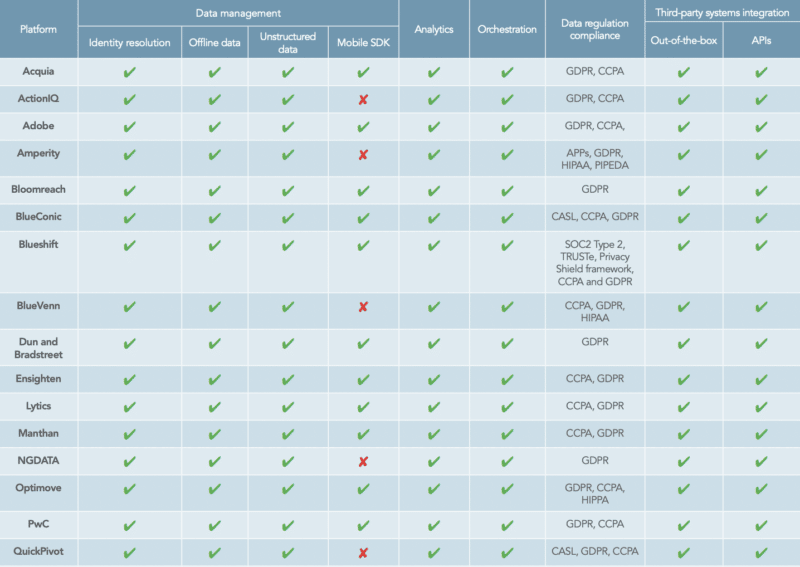
Explore platform capabilities from vendors like Blueconic, Tealium, Treasure Data and more in the full MarTech Intelligence Report on customer data platforms.
How do we currently manage customer data?
Fragmented pieces of customer data often reside in silos in marketing, sales, purchasing, customer support and other departments. Does your organization have a system that serves as the ultimate authority on customer profiles? Do you know what customer data it includes? Is third-party anonymous data mixed in? How many applications are in your martech stack? And how does data get from one application to another? Is it transferred in real-time? Every hour? Every day? These are all areas where a CDP can help to standardize and streamline data storage and processing. However, another tool you’re using may already handle some of the CDP functionality you’re seeking.
How efficient are our marketing data processes?
Marketing software applications are supposed to improve data and campaign efficiency. But many times, disparate systems lead to data duplication, lack of standardization and an increase in time-consuming manual tasks. If you find yourself spending more time normalizing data or de-duplicating contact records, and less time executing campaigns or evaluating campaign performance, it might be time to automate data integration.
How would a CDP address our business needs and what are our use cases for the technology?
Virtually all CDPs deliver several core capabilities around data management, but many also provide a wide range of data analytics and orchestration features that address diverse business goals. What would having a single view of your customers do for you? For example, do you want to reduce churn by targeting customers with more relevant offers? Or increase the profitability of customer acquisition efforts by creating more accurate lookalike audiences? Don’t invest in a CDP before developing use cases that demonstrate how adoption will improve marketing performance or reduce costs. The investment should more than pay for itself.
Is your organization ready for a CDP?
Do you have enough clarity on your use cases and customer journeys to enable you to choose the correct solution? How will centralizing your data and audience definition impact your organization? Are you confident that all of the teams that would need to be involved — from IT to marketing to customer service — can be educated on the potential value of a CDP as part of the adoption project? Have you chosen early adopters within the organization that can provide proof points to other users?
What systems would we integrate through the CDP?
The martech stack is getting bigger and more complex for many organizations. Streamlining integration is a core benefit of implementing a CDP, which can normalize data for easier importing and exporting into other systems. As more brands engage in omnichannel marketing through numerous martech apps, creating a unified view of the customer has become critical to marketing success.
How will we define and then benchmark CDP success?
What key performance indicators (KPIs) do you want to measure, and what decisions will you make based on CDP implementation? For example, do you want to decrease data redundancy and track how that impacts the velocity of campaign execution? Or do you want to decrease the time your marketing staff spends on manually transferring data from one system to another? Set business goals in advance to be able to benchmark success later on. More than ever before, businesses seek to quantify the ROI of their martech investments.
Do we have management buy-in?
As with any major organizational investment, management support is essential to CDP success. Begin with small, short-term goals that demonstrate how the CDP is benefiting the business, either through cost savings or revenue gains. The key is to convince senior executives that having a single, unified view of the customer will add to the organization’s bottom line.
Do we need self-serve, full-serve or something in between?
CDPs are typically built for marketing end-users. However, CDPs vary in the scope of their capabilities — and it is important to have some level of ongoing training to use them all. CDP vendors provide varying levels of onboarding, customer support and/or professional services. Make sure you understand what your marketing staff will need to know to effectively use the CDP, or if you lack internal resources, what type of managed services are available?
What is the total cost of ownership?
CDP vendors charge monthly license fees based on the number of data records, events (or customer actions) and applications integrated. There may be additional fees for onboarding, APIs/custom integrations or staff training. Make sure you know your business needs, data volume and how you will need to restructure your systems and staff to enable a CDP’s operations. Being aware of all of these aspects will help you understand the investment your organization will make. Keep in mind, too, that you may see cost savings if the system allows people to work more efficiently. (Go here for a deeper look at how much a CDP costs.)
Our new report, “Customer Data Platforms: A Marketer’s Guide” is now available for free download.
Get MarTech! Daily. Free. In your inbox.
Customer data platforms: A snapshot
What they are. Customer data platforms, or CDPs, have become more prevalent than ever. These help marketers identify key data points from customers across a variety of platforms, which can help craft cohesive experiences. They are especially hot right now as marketers face increasing pressure to provide a unified experience to customers across many channels.
Understanding the need. Cisco’s Annual Internet Report found that internet-connected devices are growing at a 10% compound annual growth rate (CAGR) from 2018 to 2023. COVID-19 has only sped up this marketing transformation. Technologies are evolving at a faster rate to connect with customers in an ever-changing world.
Each of these interactions has something important in common: they’re data-rich. Customers are telling brands a little bit about themselves at every touchpoint, which is invaluable data. What’s more, consumers expect companies to use this information to meet their needs.
Why we care. Meeting customer expectations, breaking up these segments, and bringing them together can be demanding for marketers. That’s where CDPs come in. By extracting data from all customer touchpoints — web analytics, CRMs, call analytics, email marketing platforms, and more — brands can overcome the challenges posed by multiple data platforms and use the information to improve customer experiences.
About the author

Pamela Parker is Research Director at Third Door Media’s Content Studio, where she produces MarTech Intelligence Reports and other in-depth content for digital marketers in conjunction with Search Engine Land and MarTech. Prior to taking on this role at TDM, she served as Content Manager, Senior Editor and Executive Features Editor. Parker is a well-respected authority on digital marketing, having reported and written on the subject since its beginning. She’s a former managing editor of ClickZ and has also worked on the business side helping independent publishers monetize their sites at Federated Media Publishing. Parker earned a master’s degree in journalism from Columbia University.
Read More
Pamela Parker